I was recently interviewed by Martin Maier from GEWINN, a leading Austrian business magazine. We talked about my research with Jürgen Huber and Stefan Zeisberger into the factors driving risk perception and, indirectly, prices in capital markets. Read the full interview at: GEWINN WebsiteGEWINN Magazine
The year started on a positive note when we learnt that Kerstin Mitterbacher, a PhD student of mine, was granted a 2-year DOC stipend by the Austrian Academy of Sciences. She will now be able to focus her full attention on her research in the project titled “Migration and Integration”. The objective of Kerstin’s work will be to show how the willingness of migrants to integrate into the society of their destination countries and the willingness of destination country citizens to welcome such migration and integration interact, and which factors promote successful outcomes. Kerstin will run laboratory experiments at the University of Graz’ Max Jung Lab together with Jürgen Fleiß and myself.
When giving presentations at conferences or in research seminars, there is always the question of how to get the presentation onto the presenter computer. This involved me having to remember to put the presentation on my USB drive, in the latest version, remembering to bring the USB drive, searching for my USB drive in the seminar room, getting the computer to recognize my USB drive, and finally getting my presentation onto the computer. I have now found a much more convenient option: Create a folder for your presentations in your Dropbox, Onedrive, or whatever cloud space you favor1 Create a share link to the folder Use an URL shortener (like bitly.com, tiny.cc, TinyURL.com,…) to shorten the unwieldy link to something more manageable, like bit.ly/StefansTalks Once you have prepared the infrastructure this way, simply save the presentation to the local presentation folder (and wait long enough for your cloud space client to upload it). When at the presenter computer, just head to your version of https://bit.ly/StefansTalks and fetch your presentation from there. Now just remember to bring your good ol’ USB drive in case the presenter computer does not have2 internet…
The term “wisdom of crowds” is well-recognized at least since the publication of James Surowiecki’s book with the same title. It refers to the phenomenon that the aggregated estimates of many different individuals often constitute a surprisingly accurate predictor of the unknown quantity or quality to be estimated. In our latest paper, co-authored with Jürgen Huber and Larissa Senninger from the University of Innsbruck, I study which aggregation mechanism performs best. We compare simple means and medians and more complex, market-based mechanisms. We find that the continuous double auction outperforms all other mechanisms in terms of prediction accuracy. Palan, S., Huber, J., Senninger, L., Forthcoming. Aggregation mechanisms for crowd predictions, Experimental Economics, DOI: 10.1007/s10683-019-09631-0.
What do investors perceive as risky? And if what they perceive as being risky differs from what finance theory suggests constitues risk – does the market eliminate any potential biases from individual risk perceptions? These are the core questions pursued in a joint paper with Jürgen Huber and Stefan Zeisberger and recently published (online first) in the Journal of Banking and Finance. Titled “Does Investor Risk Perception Drive Asset Prices in Markets? Experimental Evidence”, the paper finds that investors nearly exclusively focus on an asset’s probabilty of yielding negative returns. In other words, risk perception is driven by the probability of losses, while for example the size of the potential losses does not seem to receive investors’ attention. While this result confirms prior research by some of the authors, finance theorists would rely on a market to eliminate any individual biases, yielding efficient prices, which properly reflect more comprehensive risk measures. Yet the paper’s most important finding is precisely that this mechanism does not work. The results show that real-money experimental asset market prices fully reflect the individual risk perceptions. Assets with a higher probability of negative returns fetch lower prices in the market and vice versa. This has important implications for markets outside of the lab, for individual investors, and for investment advisors, who should account for this bias. Huber, J., Palan, S., Zeisberger, S., 2019. Does Investor Risk Perception Drive Asset Prices in Markets? Experimental Evidence, Journal of Banking & Finance 108(105635)., DOI 10.1016/j.jbankfin.2019.105635. See also: Börse Social Network [German] idw – Informationsdienst Wissenschaft [German] Kleine Zeitung [German] pressetext [German] University of Graz website
A joint paper with Marcus Giamattei, Jürgen Huber, Johann Graf Lambsdorff and Andreas Nicklisch, titled “Who inflates the bubble? Forecasters and traders in experimental asset markets”, has recently been published (online first) in the Journal of Economic Dynamics and Control. It experimentally studies the interaction of traders and analysts and teases apart their respective roles in producing bubble patterns. We find the greatest bubbles in settings where the roles of trader and analyst are clearly separated, with traders trying to maximize their trading profit and analysts being paid for their forecasting accuracy. Giamattei, M., Huber, J., Lambsdorff, J. G., Nicklisch, A., Palan, S., 2020. Who inflates the bubble? Forecasters and traders in experimental asset markets, Journal of Economic Dynamics and Control 110, DOI: 10.1016/j.jedc.2019.07.004.
The University of Graz has elected a new senate in which I will serve as a senator from October 2019. I look forward to this new challenge and to working for my alma mater in this new capacity!
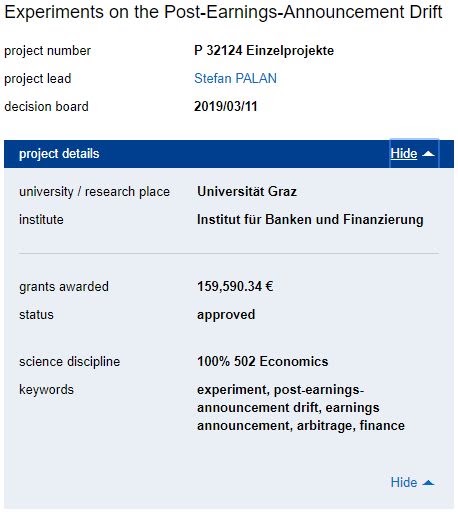
The Austrian Science Fund (FWF) has decided to fund my joint grant application with Erik Theissen, titled “Experiments on the Post-Earnings-Announcement Drift”. In this research proposal, we plan to study the causes and mechanisms behind the phenomenon that stock prices tend to drift upward (downward) over extended periods of time following positive (negative) earnings news. Given the funding now granted, my team and I will be able to hire a PhD student to conduct experiments to explore several potential explanations for why post-earnings-announcement drift occurs.
Our research platform FiRe has just published its annual report. We had a very productive year and report on a lot of research activity, including new initiatives like a public lecture series, the FiRe lecture. Read more here.
I recently had my eleven minutes of fame when I featured in a report in ProSieben’s (a TV station) Galileo magazine. Galileo presents news from the realm of science and technology to a general audience of between 1m and 2m German-speaking viewers. In this case, we did a little experiment to explore which ‘tricks’ a waiter can use to earn larger tips. See for yourself how that worked out!