
I am proud to announce that together with my colleague Andrea Schertler, I am participating in the Finance Crowd Analysis Project, the first crowd-sourced community paper in Economics/Finance. Together, more than 160 research teams analyzed a dataset of 720 million trades and crafted a joint paper reporting the results. Learn more in the video below or in the working paper.
spalan
-

Managing Director of the Society for Experimental Finance
After the international SARS-COV-2 pandemic necessitated the cancellation of the Society for Experimental Finance’s 2020 annual meeting, the University of Innsbruck organized this year’s meeting online via GatherTown. The attendees enjoyed a total of 88 paper presentations, 2 keynotes (by Annamaria Lusardi and Stefan Nagel) and 2 talks with a view (by Michael Kirchler and Roberto Weber). As part of the program, the society held its annual meeting, which elected a new managing board, with Sascha Füllbrunn as Secretary, Anita Kopanyi-Peuker as Treasurer and myself as Managing Director. I look forward to this responsibility and challenge.
-

My PhD student Josef Fink completes his degree with top grade
Today Josef Fink completed his doctoral studies with a dissertation defense that the committee graded “Sehr gut”, the top grade in the Austrian grading system. Josef’s dissertation, titled “Experiments on the Post-Earnings-Announcement Drift”, was also graded “Sehr gut”. In its core, it is made up of three papers studying the phenomenon of stock prices drifting in the direction of the surprise component of a company’s announced earnings for up to four quarters following the initial announcement. In his first paper, titled “A Review of the Post-Earnings-Announcement Drift” and published in the Journal of Behavioral and Experimental Finance, Josef provides the most comprehensive (by a wide margin) review of the literature on the PEAD phenomenon to date. In his second paper, titled “Earnings Autocorrelation and the Post-Earnings-Announcement Drift“, Josef studies the role of autocorrelation in the earnings process on the drift. In his third paper, titled “Trading Frictions and the Post-Earnings-Announcement Drift“, Josef investigates the role of frictions (i.e., a short-selling ban and transaction fees) on the drift. I am proud of Josef and congratulate him to this impressive achievement!
-
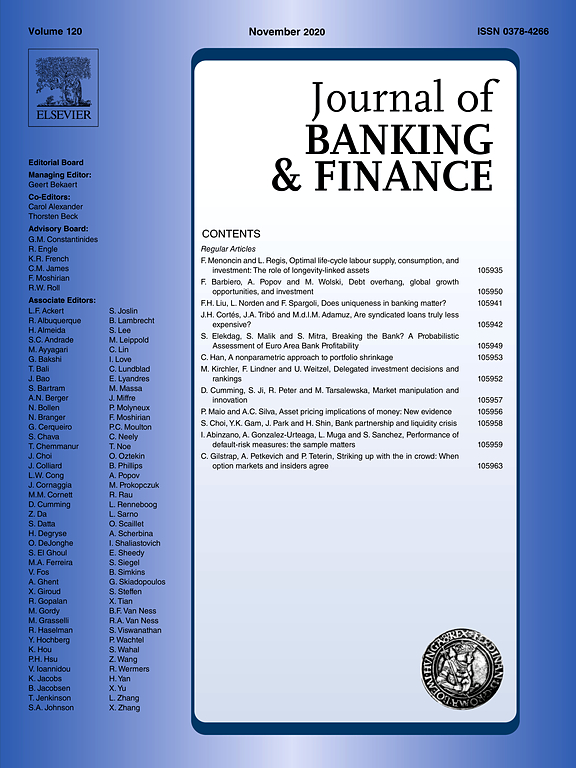
New Paper on Insider Trading and Short Selling Regulation
Modern capital markets are subject to many interventions and regulations, some of which curtail the implementation of specific trading strategies in a market. While we understand much of these regulations’ individual effects, the picture is less clear about their joint effects. A new paper, jointly authored by Robert Merl (University of Graz), Thomas Stöckl (MCI Management Center Innsbruck) and myself considers the interaction of two regulations, namely rules limiting shorting of assets and cash, and rules limiting insider trading. For these regulations, prior research shows spikes in short-selling activity around the revelation of insider information, which different studies trace to different causes. Among other results, we find that both allowing short positions and allowing informed trading causes informed traders to increase their market activity and causes mispricing and spreads to diminish. Nevertheless, we find no evidence for significant interaction effects between the two regulations. Merl, R., Stöckl, T., Palan, S., 2022. “Insider trading regulation and shorting constraints. Evaluating the joint effects of two market interventions”, Journal of Banking and Finance, 106490, DOI: https://doi.org/10.1016/j.jbankfin.2022.106490.
-

New working papers out
The first quarter of the year has been a busy one, with two papers submitted and two new working papers published. In “Trading frictions and the post-earnings-announcement drift“, Josef Fink, Erik Theissen and I study the effect of a short selling ban and transaction fees on the post-earnings-announcement drift. We find evidence for lower trading activity and higher asset prices in the presence of these types of frictions. In “A Critical Perspective on the Conceptualization of Risk in Behavioral and Experimental Finance“, Felix Holzmeister, Christoph Huber and I discuss the conceptualization of “risk” in finance, urging researchers to clearly distinguish between risk preferences, risk perceptions, and risk taking. I welcome all thoughts and comments on these papers and topics!
-

Free, online z-Tree course
I have spent the past weeks and months preparing a fully-fledged online z-Tree course, which is free for everyone (published under a CC-BY-SA license). It is designed to allow beginners with no prior z-Tree experience to learn all they need to start programming their own simple and not-so-simple experiments. I hope it will prove helpful to you and welcome any feedback you may have!
-
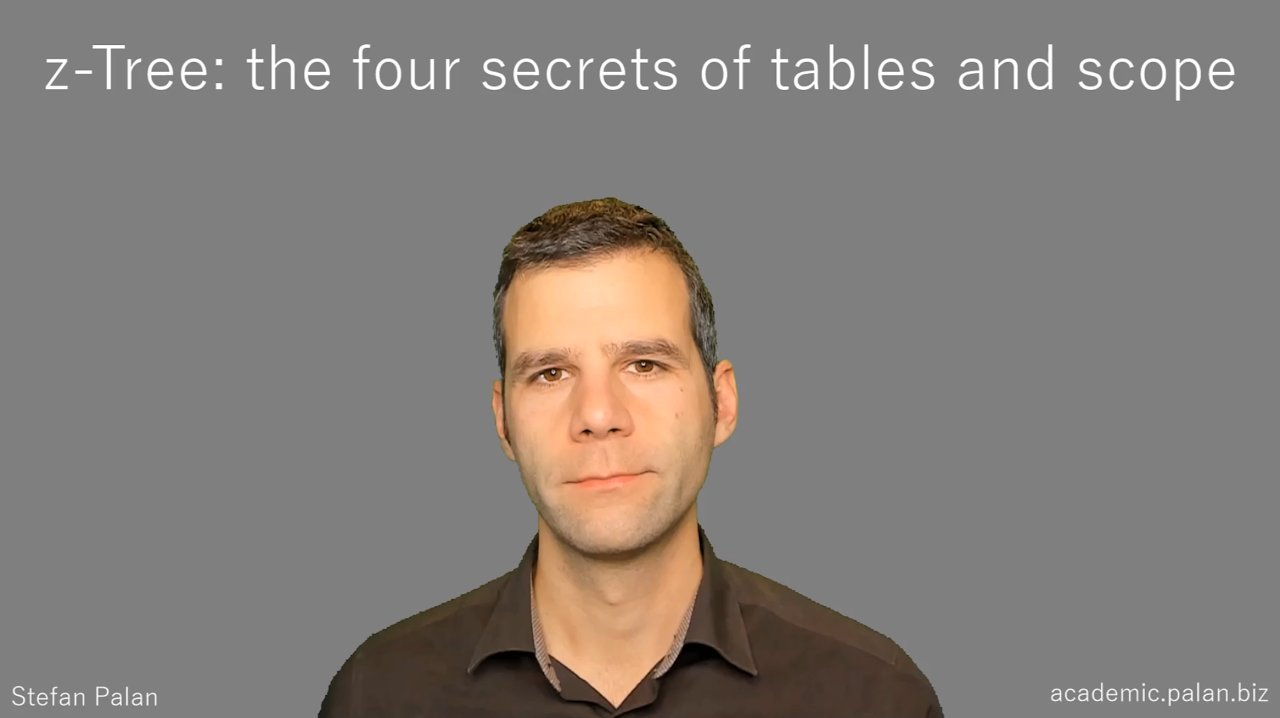
New video explaining tables and scope in z-Tree
Have you sometimes struggled to understand how tables and the scope operators work together in z-Tree? I am just in the process of preparing an online z-Tree course, putting my new recording studio equipment to good use. In the process of preparing this course I have prepared a short (16min) video, explaining this crucial z-Tree concept. Be sure to check it out below, and let me know if you have any feedback!
-

New paper studying the post-earnings-announcement drift
Together with Josef Fink and Erik Theissen, I have recently published a new working paper stuying the post-earnings-announcement drift (PEAD). In the first experimental study of this pricing anomaly, the three researchers show that autocorrelation in earnings surprises is not a necessary condition for PEAD. Rather, such autocorrelations strengthens a drift that is also present in its absence. The paper then goes on to document that the drift can be profitably exploited even after accounting for transaction costs, and that greater earnings surprises are connected to greater drift, likely due to investors underreacting to earnings autocorrelation. Link to the paper: https://ssrn.com/abstract=3713106
-

New paper studying the disposition effect
I have just published a new working paper studying the disposition effect. Following a seminar presentation at the Université catholique de Louvain in October of last year, I joined the research project of Rudy De Winne and Nhung Luong, who study whether investors whose behavior exhibits the disposition effect choose different order types and different limit prices than investors less prone to the disposition effect. We are able to report strong evidence supporting this conjecture from a comprehensive analysis of a large dataset of millions of trades by thousands of Belgian retail investors. For the next version of the paper, we aim to run experiments to document causal relationships. Link to the paper: https://ssrn.com/abstract=3657007
-
Short video explaining the review and publication process
I recently looked for a short video explaining how the review and publication process works at research journals. I intended to (and did) use it to give the students in one of my courses a short primer, before discussing some referee reports with them. I found the following video, which does the job so nicely that I decided to share it with you: